
SMART MOBILITY & EV INFRASTRUCTURE
Connected transport. Intelligent charging. Designed around the development.
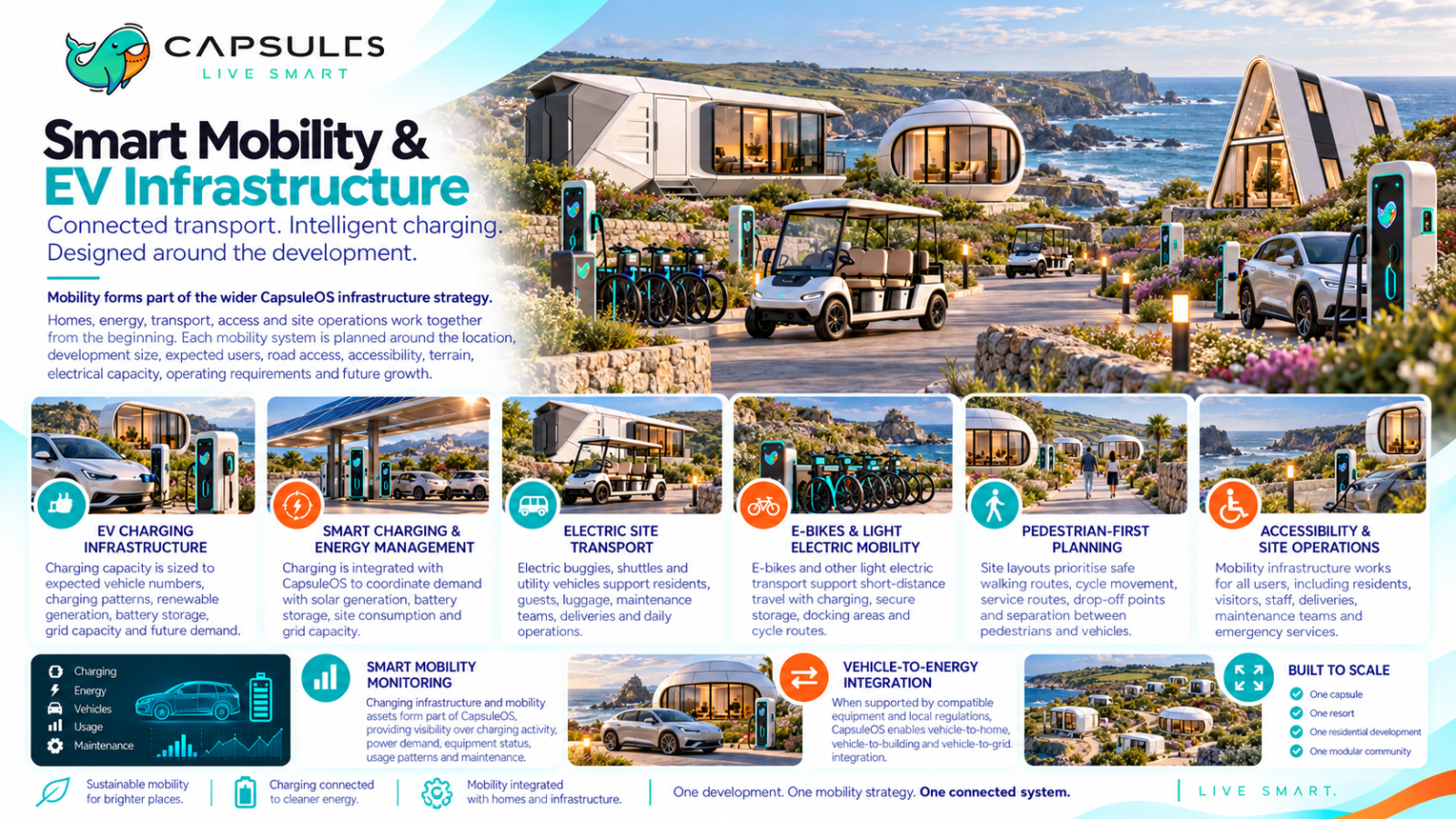
Mobility forms part of the CapsuleOS infrastructure strategy.
Homes, energy, transport, access, and site operations should work together from the beginning.
Each mobility system is planned around the location, development size, expected users, road access, accessibility, terrain, electrical capacity, operating requirements, and future growth.
From a single capsule to a resort or larger modular community, CapsuleOS connects mobility infrastructure with the wider energy and site-management system.
EV CHARGING INFRASTRUCTURE
EV charging is planned alongside the development’s electrical infrastructure.
Charging capacity is matched to expected vehicle numbers, charging patterns, available power, renewable generation, battery storage, grid capacity, and future demand.
Projects range from individual charging points to shared charging hubs serving residents, guests, staff, service vehicles, and site operations.
SMART CHARGING & ENERGY MANAGEMENT
Charging becomes more efficient when managed as part of the wider energy system.
Compatible EV infrastructure integrates with CapsuleOS to coordinate charging demand with solar generation, battery storage, site consumption, and available grid capacity.
This supports better use of locally generated energy and helps manage periods of higher electrical demand.
ELECTRIC SITE TRANSPORT
Larger developments often require dedicated transport within the site.
Electric buggies, shuttle vehicles, utility vehicles, and other low-speed electric transport support residents, guests, luggage, maintenance teams, deliveries, and daily operations.
Vehicle selection is based on distance, terrain, passenger capacity, accessibility, payload, charging requirements, and operating hours.
E-BIKES & LIGHT ELECTRIC MOBILITY
Light electric transport supports efficient movement across larger sites and nearby destinations.
Depending on the project, infrastructure includes e-bike charging, secure storage, docking areas, shared mobility points, and designated cycle routes.
PEDESTRIAN-FIRST PLANNING
The best mobility strategy also reduces unnecessary vehicle movement.
Site planning prioritises safe walking routes, access to shared facilities, cycle movement, service routes, drop-off points, emergency access, and separation between pedestrian and vehicle areas where appropriate.
This creates quieter, safer, and better organised spaces around homes and community facilities.
ACCESSIBILITY & SITE OPERATIONS
Mobility planning must work for every part of the development.
Routes, parking, drop-off areas, servicing access, internal transport, and accessible movement are considered together with the physical site layout.
This supports residents, visitors, staff, deliveries, maintenance teams, and emergency services.
VEHICLE-TO-ENERGY INTEGRATION
Electric vehicles increasingly form part of the wider energy ecosystem.
Where compatible vehicles, charging equipment, project requirements, and local regulations support the technology, CapsuleOS architecture supports vehicle-to-home, vehicle-to-building, and vehicle-to-grid integration.
This creates additional flexibility between transport, battery storage, renewable generation, and site energy demand.
SMART MOBILITY MONITORING
For larger developments, charging infrastructure and selected mobility assets form part of the CapsuleOS monitoring layer.
Operators gain visibility over charging activity, power demand, equipment status, usage patterns, faults, and selected transport operations.
This supports maintenance, capacity planning, and more efficient day-to-day management.
BUILT TO SCALE
Mobility infrastructure grows with the development.
One capsule.
One resort.
One residential development.
One modular community.
Walk.
Ride.
Charge.
Move.
Manage.
Transport designed around the site.
Charging connected to the energy system.
Mobility integrated with the wider infrastructure.
One development.
One mobility strategy.
One connected system.
LIVE SMART.
