
MODULAR INFRASTRUCTURE & UTILITY HUBS
Centralised infrastructure. Modular deployment. Designed to grow with the project.
CapsuleOS brings essential technical infrastructure together through modular utility hubs designed around each development.
Energy, water, wastewater, monitoring, controls, communications, and service equipment form one coordinated infrastructure strategy.
Where centralisation makes sense, key systems sit within dedicated technical hubs. This creates a clearer structure for installation, operation, maintenance, resilience, monitoring, and future expansion.
PROJECT-SIZED INFRASTRUCTURE
Every site requires its own infrastructure architecture.
Capacity is determined by occupancy, number of capsules, electrical demand, water requirements, wastewater strategy, site layout, maintenance access, resilience requirements, and planned growth.
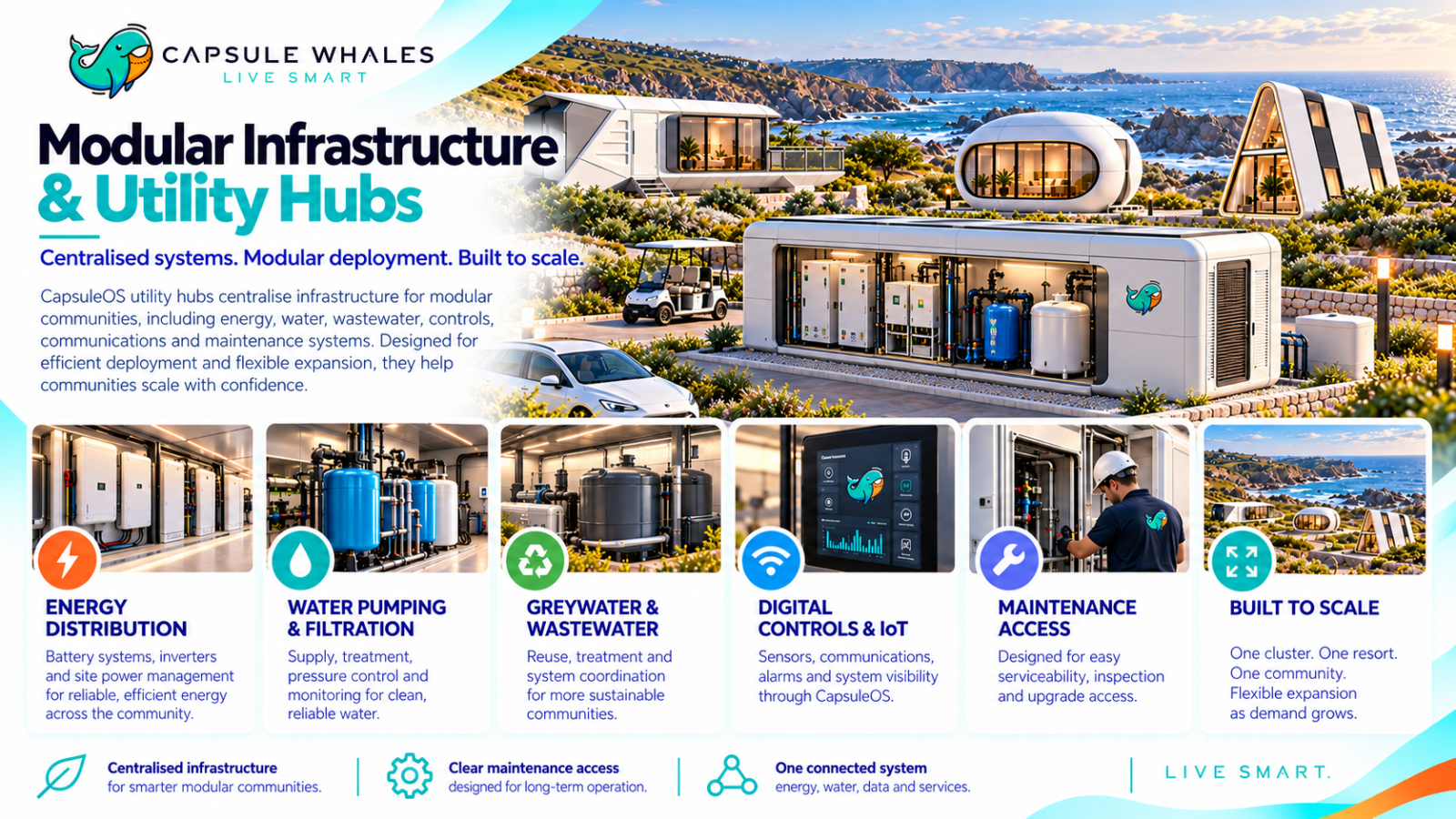
A smaller development might operate from one compact utility hub.
Larger projects might use several distributed hubs or a central infrastructure plant serving different zones.
The infrastructure is designed around the project from the beginning.
ENERGY INFRASTRUCTURE
Utility hubs bring key energy equipment into one organised technical environment.
Depending on project requirements, this includes battery energy storage, PCS equipment, inverters, electrical distribution, protection systems, controls, communications equipment, and backup infrastructure.
These systems connect renewable generation, EV charging, individual capsules, shared facilities, and wider site loads through the CapsuleOS energy architecture.
WATER INFRASTRUCTURE
Water infrastructure is designed around available sources, required capacity, water quality, and demand.
Utility hubs support pumping, filtration, purification, storage management, pressure control, distribution, and monitoring.
Water sources include mains supply, boreholes, rainwater harvesting, atmospheric water generation, desalination, or suitable combinations selected for the site.
The objective is reliable water infrastructure with clear operational control and straightforward maintenance.
WASTEWATER & WATER REUSE
Where decentralised treatment is required, utility hubs support wastewater collection, pumping, treatment, greywater management, water reuse, and associated controls.
System design reflects occupancy, treatment capacity, discharge requirements, environmental conditions, site constraints, and local standards.
Water supply, treatment, reuse, and wastewater management are planned as one coordinated strategy.
DIGITAL CONTROL & MONITORING
Every utility hub connects with the wider CapsuleOS digital layer.
Sensors, controls, communications systems, alarms, and monitoring provide clear visibility across essential infrastructure.
Selected data includes energy performance, battery status, water systems, treatment equipment, capacity, faults, maintenance requirements, and operational performance.
This brings complex technical infrastructure into one cleaner operating environment.
MAINTENANCE & SERVICE ACCESS
Infrastructure must remain accessible throughout the life of the development.
Dedicated technical areas support inspection, servicing, component replacement, system upgrades, and future expansion.
Centralised service access reduces disruption to individual homes and gives technical teams a structured environment for maintenance and asset management.
RESILIENCE & REDUNDANCY
Larger developments need infrastructure designed for continuity as well as capacity.
Where required, the architecture includes backup equipment, redundancy, system isolation, and alternative operating routes.
This limits the effect of individual equipment failures and supports reliable operation across the wider development.
BUILT TO SCALE
CapsuleOS infrastructure grows with the project.
A development starts with the systems required today and expands as additional capsules, services, loads, and shared infrastructure are introduced.
One capsule.
One cluster.
One resort.
One modular community.
Centralise where practical.
Distribute where needed.
Monitor continuously.
Maintain efficiently.
Expand with demand.
One development.
One infrastructure strategy.
One connected system.
LIVE SMART.
